
Showing posts with label LeagueInfo. Show all posts
Showing posts with label LeagueInfo. Show all posts

Roster Locking, Draft Positions, Finals Format
Just for clarification purposes:
(1) If you were in the playoffs and you lost, it's over for you. Your roster will lock tomorrow. No more games, nothing. Thanks for a good season.
(2) If you lost in the Toilet Bowl, you still play another game to determine the #3 overall pick. Once you win-lose that game, your rosters lock -- which would be next Monday.
(3) For next year's draft, teams that exit the playoffs and don't make the Finals, are slotted Picks #5-#10 in reverse order of the regular season standings.
(4) If you make the Finals, the team that loses the championship game drafts #11, the team that wins drafts last, #12.
The Finals will run Mon-Sun, like a normal week, even if the nba.com site tabulates through the end of the regular season. We'll just cut it off the Sunday of championship week and not count the last 2-3 days of games.
Note: Next year's supplemental draft is NOT snake. So if you have the #2 pick, you get that pick for every round we have the supplemental draft.
(1) If you were in the playoffs and you lost, it's over for you. Your roster will lock tomorrow. No more games, nothing. Thanks for a good season.
(2) If you lost in the Toilet Bowl, you still play another game to determine the #3 overall pick. Once you win-lose that game, your rosters lock -- which would be next Monday.
(3) For next year's draft, teams that exit the playoffs and don't make the Finals, are slotted Picks #5-#10 in reverse order of the regular season standings.
(4) If you make the Finals, the team that loses the championship game drafts #11, the team that wins drafts last, #12.
The Finals will run Mon-Sun, like a normal week, even if the nba.com site tabulates through the end of the regular season. We'll just cut it off the Sunday of championship week and not count the last 2-3 days of games.
Note: Next year's supplemental draft is NOT snake. So if you have the #2 pick, you get that pick for every round we have the supplemental draft.

Rules Add-Ons and Updates
 Playoffs:
The top 4 teams from each conference enter the playoffs. Top seeds have tie-breaker advantage should the scoring for the week come up even.
The final Championship Week is (possibly) more than seven days. Traditionally, the scoring goes more than the allotted seven days to make up for the last few days of the NBA regular season.
Toilet Bowl:
The remaining four non-playoff teams participate in a toilet bowl playoffs. The winner of the Toilet Bowl gets the first overall pick, the loser of the Toilet Bowl gets the second pick, and so on.
Teams for this playoff compete first within their own conference and then move into the Toilet Bowl against the winner/loser from the opposing conference.
This Toilet Bowl playoff insures that all 12 teams compete for something until the very end of the season.
Roster Lock:
As soon as a team is eliminated from post-season contention, their roster is locked until the supplemental draft (see below).
The reason for this is so that nobody can pick up players during the summer and pre-season (and after they've been eliminated from the playoffs) before we have our supplemental draft.
Supplemental (Yearly) Draft:
The new draft will occur as close to the start of the next regular season as possible. It will be 2-3 rounds (undetermined for now).
The draft order will be as determined by the Toilet Bowl, then in reverse regular season standings BUT with the two Finals contestants receiving the last two picks.
This yearly draft is not in snake order.
Keeper:
We keep all fifteen players on our roster, up till and including, the Supplemental Draft players. We'll then have a set date by when owners have to release players to get down to 15 men, and those players cut after the supplemental draft will go through the normal waiver wire process.
There have been suggestions that we should cut before we draft, but that might compromise the youth or injury players that most teams have at the end of the bench.
So, we'll have 15 keepers, draft 2-3, then cut back down to 15 players before the start of the season.
Next Year:
We will try to get off NBA.com next year since their interface sucks. Ideally we'd use Yahoo if they can do conferences.
We'll revisit the scoring (not the way we score, but perhaps moving to averages if we can) and the weekly versus daily lineup debate.
Be assured that any new rules will maintain roster and scoring integrity and concept from the original rules.
Original Rules
The Great Debate
 Most fantasy basketball leagues run daily lineup changes. We've always used weekly lineup changes and we've debated the issue quite a bit before starting this league. Here's our rationale for choosing weekly versus daily lineup scoring.
Churning
In a normal H2H league with no limit to how many games played your team can have [See: Games Played], most people would choose to "churn" their lineup by just clicking along to each day and getting as many players as possible to play each week in an attempt to out-game the opposition. In a non-keeper league, this is a great idea as the bottom of your roster is probably filled with marginal players so you might as well dump them to pick up another marginal player who has more games scheduled that week.
For us, churning won't be as much of a factor because every man on our roster is valuable. They are all keeper players and potential stars or at the very least, contributors.
The traditional defense pro-churning is that an owner runs the risk of dropping a potentially good player if they run their roster ragged by pulling and pushing players into their lineups every day. The negative, and risk, to churning then is: You drop someone good, he might get taken by the opposition. This opinion does makes sense, to an extent. For the most part though, anyone player who is being churned isn't likely to be that good anyway. I'm not gonna lose any sleep over someone picking up Brian Skinner after I've already used him up for the week. Nobody's dropping a good player for churning purposes and the chances of you not wanting to drop a marginal guy just in case he gets really good is pretty slim.
I don't see the positives of allowing churning, especially with the way our league is set up. We decided it's not worth doing daily lineups for churning purposes since our keeper league is built to be low-churn anyway.
 Starting Lineup
Because we only have ten players eligible for play each week, our bench acts like a holding que, sort of like a practice squad if you will. Since we are playing such a long keeper length (3 years), people like to speculate and grab young players that may not be ready to contribute now, but could grow into powerhouses in the future. These young players can sit on the bench and learn from the starters.
If we went to a daily lineup however, young players would be forced into action as both teams try to churn their way to victory. This can hurt a team who is hoarding a few young studs on the bench. Changes the draft strategy (which we already conducted) doesn't it?
Also, having an injured player on your roster/bench brings down your available players each week. If you are waiting on Grant Hill and Pau Gasol to come off the injury list in two months, you'll stuck going 13-on-15 until they get back. A pretty big disadvantage.
That's one reason we chose weekly over daily; in order to maintain a true starting lineup and not to extend our entire roster to 15 playable players each week, which could hurt teams with young and injured players.
Strategy
Many owners have said that they enjoy added strategy of micro-managing their basketball rosters each day. They like the ability to go in there and sub in a guy for extra REB if they are a little behind going into the weekend. While I agree this is strategy, I'm not certain it's actually "added" strategy.
Making your lineup decisions earlier in the week is just as strategic as doing later in the week. How many times have you really been able to affect the outcome of your week by subbing in a guy for a few extra PTS? Usually you just ride the best players and hope for a big game from someone to catch up.
 With locked (weekly) lineups, if you think you're going to be close in REB and BLK but likely to win handily in 3PT and STL, you can choose to take out Smush Parker for Darko on Monday. In fact, it can be argued that by having to make, and stand by, your weekly choices, this forces more strategy and foresight into the process. You have to actually scout out your opponent and then enter into the battle with a lineup that can't change. If you can change players daily, you just keep the games played number high and hope for the best; you don't really have to pay attention to who you're playing each week since your whole roster is available to you.
It's nice to be able to simulate real-time strategy during daily lineups and there's something to be said for switching players mid-week -- in order to simulate the changes a coach might make at, say, halftime -- but in my experience, people aren't strategizing as much as maximizing their roster.
If you have bench players who can make a difference in a close category, chances are, you should already be playing them. Right?
Playoffs: You've seen it, I've seen it. Two teams face off in the playoffs, last game of the season on the line. They're picking up every player with any sort of playing time each day in order to try to push through a win. That's not good managerial work, that's just busy work. We won't have this issue since we will have full keeper rosters throughout the season and the post-season, but it's something to note. I hate that playoff churning for a few extra points.
All of this is a personal preference of course. Some people like daily, some people like weekly. As with everything, there are advantages and disadvantage to both. For our purposes, we're going weekly. There's always room for change if we decide that most of us would prefer daily lineup changes, but for now, it's weekly. The only problem we're going to encounter with daily changes is injury issues [See: Injuries] and to a lesser extent, games played. But the latter problem is unavoidable with any lineup system.
I just wanted to lay down some of the thinking that went behind the decision to go with weekly lineup changes.
Commissioner Speak: Injuries
 The Problem
Injuries are a bitch. Injuries that occur to you during the week can be a double bitch. Right now, we are set up for weekly lineup changes, so that means if say, Baron gets hurt for a few games on a Tuesday during his first game of the week, you are stuck with his big fat zeros for the rest of the scoring period. That can really hurt. With daily lineup changes, you can just sub the injured guy out and roll right along. With weekly lineup changes, that's a bit tougher.
Analysis
We have a few solutions for this problem, none of which we've implemented yet because we're not sure what the best solution is.
(1) "The Substitution Method" -- Allow one sub per week.
The details of how this would work could get a bit murky but it would essentially allow an owner to pull out a player at any time during the week for a player from his bench. There are two ways to do this:
(a) You can only pull out an injured player mid-week. They have to leave the game they were playing and can't re-enter that game to be considered injured.The problem with this solution is that the Commish(es) would have to re-set the scoring when a person is pulled. And currently, with weekly lineup sets, you can only take out a player's entire scores, not just say, his scores from Monday and Wednesday, and then add in the scores from another player for Friday and Sunday.
(b) You can pull out any player mid-week even if they're not injured. This then allows you to take out an under-performing player for a hot one on the bench. This option is clean, neat, and could add an interesting strategic dynamic.
(2) "The Trust Method" -- Just set the system to daily changes but only allow non-injury related lineup changes on the pre-set date (Monday).
Then if a player gets hurt, the owner can just take him out and insert the sub for the rest of the week without messing up the current (or historical) scoring.
The tremendous downside of this is that owners must be aware of what is going on with their opponent (even if the IR switch is declared publicly) and stay up to date on both of their lineups.
Plus, owners have to remember to set their lineups ONLY on Monday. We're not sure this can be enforced the whole season. It depends on how active and attentive we are as a group.
(3) "The Half and Half Method" -- Allow an IR substitution only early in the week.
Owners can sub in for an IR player only on injuries that occur during the early part of the week (Monday-Wednesday?). This will eliminate missing an entire week's worth of games while still giving owners a chance to make up for some of those IR games.
The question is, what do we do with the sub's stats from the early games? I say we just let all of the new player's stats count, and eliminate the old player's. This kinda sucks, but it's the easiest way to do it.
Or we can fill out depth charts and designate, say, one or two players each week as subs, and the owner can only put in that pre-determined player. Thus we don't have the "benefit" of hindsight when choosing subs from the bench.
We're not considering allowing owners to use an injury sub for every injury during the week, just one substitution at most.
 Conclusion
The thing we need is a way to deal with the mid-week injuries that can really cripple a team. We want the solution to be easy to enforce, easy to update, won't allow for lineup "cheating," and will allow for an injured player to leave while getting a useful sub in from the bench. Since no elegant solution has presented itself, we're currently leaving the injury situation at status quo. If your guy gets hurt, too bad.
We are considering any of the aforementioned options, while leaving the door open for suggestions. Keep in mind that we need simplicity and fairness. If we don't settle this issue soon, we're just gonna ride with weekly lineup changes with no substitutions -- for better or for worse. So speak up if you have an opinion.
Here's my two cents: I'm personally of the opinion that you do have to factor propensity for injury into a player's value. It's obviously very harmful if you consistently lose players each week, especially mid-week. That can just kill your team and your record.
Nobody can predict or control injuries, and being unable to swap an ailing player out (on a mid-week or daily basis) is a bit unfair. So some sort of solution would be nice. For now though, we go status quo just because we're not sure where to lay the responsiblity for manual IR-related moves -- onto the commissioners or the owners.
If we leave this unsettled, we're gonna have some issues with teams losing because a fourth of their roster got hurt during the week. Can we live with that?
Commissioner Speak: Games Played
The Problem
In rotisserie style, you have a 82-game limit on each position, which works to balance people's games played (GP) numbers out. However, in H2H leagues, it's always a problem matching up schedules. How do you make sure one team doesn't play more games than their opponent each week?
The two solutions are to either (a) average out a player's stats over how many games they played that week or (b) impose a games cap for the week.
 Option (a) is clearly superior but no league provider does this -- we've emailed a few of them to ask why not, no answer yet. Option (b), allowing you to set up a games cap per week is an okay compromise but it has some serious disadvantages. Once you reach that cap number, you don't accrue any more points for the week. Kobe went off for 81-points during the last game of your week? Whoops, already reached the cap, sorry. ESPN.com works around this by allowing any games played on the same day of the cap lock to still count. Of course, this can still result in lots of GP gaps, if with a slightly better variation.
Another partial solution used in conjunction with Option (b) is to take the best, say, 35 games of that week. But this rewards inconsistent players and is not a good option either.
Analysis
Our choice, given that we can't do averages, was to just let it ride. So, what happens then? In WK1 of our season, Evan will be facing off against Alvin with a -7 games disparity. That's essentially two whole players worth of games. Ouch. Maybe Evan could fix this disparity by inserting some of his bench players but the fact of the matter is that his top ten guys are just playing less games this week (31 games), while Alvin's guys are playing an exorbitant amount (38). Some quick numbers:
Notice that the second number after the slash represents how many games are available for the entire fifteen man roster. So assuming we went to daily lineup changes, you could hypothetically get 50+ games in a week (barring schedule overlaps), perhaps making a difference in that disparity, but it's not worth having to shuttle people in and out all week long.
This was one of the reasons we chose to go with weekly versus daily lineup changes [See: Weekly vs Daily]
 Conclusion
So while it sucks that we can't do averages, we have to make do with what we can. For the most part, you just play your best players and go with it. If it comes down to 2 games from Caron Butler versus 4 games from Danny Granger, maybe you go with Granger, but there's a chance those two games won't make a huge difference -- especially if you're talking about a superstar versus an average player.
It becomes part of the strategy then, to balance your GP number each week. This isn't ideal but to be quite frank, a few negative games played disparity weeks shouldn't kill your team. We go 21 weeks in the regular season; if your team sucks, you're losing regardless of a few low GP numbers -- except in out of the ordinary weeks. Right?
And to be honest, since we'll have pretty consistent rosters throughout the season, the GP for each player and each individual week should balance out. Evan's looking at the short end of the stick for two straight weeks, but that should fix itself over time. Hypothetically...
In rotisserie style, you have a 82-game limit on each position, which works to balance people's games played (GP) numbers out. However, in H2H leagues, it's always a problem matching up schedules. How do you make sure one team doesn't play more games than their opponent each week?
The two solutions are to either (a) average out a player's stats over how many games they played that week or (b) impose a games cap for the week.
 Option (a) is clearly superior but no league provider does this -- we've emailed a few of them to ask why not, no answer yet. Option (b), allowing you to set up a games cap per week is an okay compromise but it has some serious disadvantages. Once you reach that cap number, you don't accrue any more points for the week. Kobe went off for 81-points during the last game of your week? Whoops, already reached the cap, sorry. ESPN.com works around this by allowing any games played on the same day of the cap lock to still count. Of course, this can still result in lots of GP gaps, if with a slightly better variation.
Another partial solution used in conjunction with Option (b) is to take the best, say, 35 games of that week. But this rewards inconsistent players and is not a good option either.
Analysis
Our choice, given that we can't do averages, was to just let it ride. So, what happens then? In WK1 of our season, Evan will be facing off against Alvin with a -7 games disparity. That's essentially two whole players worth of games. Ouch. Maybe Evan could fix this disparity by inserting some of his bench players but the fact of the matter is that his top ten guys are just playing less games this week (31 games), while Alvin's guys are playing an exorbitant amount (38). Some quick numbers:
This shows a sampling of teams and how many games they have set up for the next two weeks.This quick analysis shows that the average GP per week should be around 33-36 games, with a high of 38 and a low of 31. It just so happens that Evan is facing Alvin this week, making for a slight aberration of games played. For the most part, the difference in GP between any two opponents should be 2 games -- which isn't too bad.
WK1, WK2 - Owner
34/50, 35/51 - Jon
34/51, 34/50 - Eric L
34/49, 36/53 - Roger
31/53, 32/53 - Evan
38/56, 36/54 - Alvin
36/49, 35/52 - Brian
Notice that the second number after the slash represents how many games are available for the entire fifteen man roster. So assuming we went to daily lineup changes, you could hypothetically get 50+ games in a week (barring schedule overlaps), perhaps making a difference in that disparity, but it's not worth having to shuttle people in and out all week long.
This was one of the reasons we chose to go with weekly versus daily lineup changes [See: Weekly vs Daily]
 Conclusion
So while it sucks that we can't do averages, we have to make do with what we can. For the most part, you just play your best players and go with it. If it comes down to 2 games from Caron Butler versus 4 games from Danny Granger, maybe you go with Granger, but there's a chance those two games won't make a huge difference -- especially if you're talking about a superstar versus an average player.
It becomes part of the strategy then, to balance your GP number each week. This isn't ideal but to be quite frank, a few negative games played disparity weeks shouldn't kill your team. We go 21 weeks in the regular season; if your team sucks, you're losing regardless of a few low GP numbers -- except in out of the ordinary weeks. Right?
And to be honest, since we'll have pretty consistent rosters throughout the season, the GP for each player and each individual week should balance out. Evan's looking at the short end of the stick for two straight weeks, but that should fix itself over time. Hypothetically...
NBA.com User Tip - Go to MY TEAMS tab >> TEAM RESULTS link >> Change the Stats drop-down box from Fantasy to Standard to see Games Played value.
Alternately, just count up how many games you have each week from your lineup page. Use a calculator, I do.
Draft Primer
We decided on 9 total categories so that we could balance our competition between the traditional big men (REB/BLK/TO/FG%) and small men(AST/STL/3PT/FT%) categories -- with PTS being the domain of everyone. Our goal is to make sure that a winning team will hypothetically be well balanced, just like an ideal NBA team should be. Real teams can't play winning basketball with five point guards or five centers, neither should our fantasy teams. Instead of using positional requirements, we hope our scoring will dictate balanced winning teams.
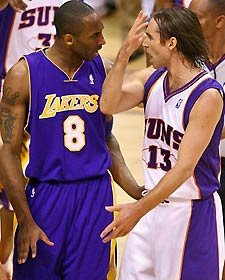 With nine categories, balance can be paramount -- just like on a real NBA team. But one of the things we've experienced in the past is a genius strategy that concentrates on one type of player in order to make sure you win 5 of the 4 categories each week. While this team didn't necessarily produce championships, it was a force to be reckoned with.
For our purposes, it's called the "small ball" team. Concentrating on just the four guard orientated categories (AST, 3PT, FT%, STL) and making sure to win PTS, a team can win handily each week by disregarding REB, BLK, FG% and TO.
The ideal small ball team would, of course, need a strong PG to provide ASTs and one of the scoring champions. In our current league, Nash and Kobe would be the ideal one -two combination. After those two, the needs are for another mid-range PG to provide some more ASTs and then all shooters for the rest of the roster. Big men who might provide provide REB/BLK/FG% are completely ignored as this team is about running and gunning.
The key here is to round out the roster with (relatively) cheap shooters who don't handle the ball much -- occassionally allowing the team to even win the turnover (TO) battle once in awhile when faced with certain matchups.
The upside of assembling this type of team is that most of the ideal players for this small ball system are often undervalued or overlooked. An ideal lineup here might look like: K Bryant, S Nash, Michael Redd, Jason Terry, Peja Stojakovic, Jameer Nelson, Wally Szerbiak, Kyle Korver, Ben Gordon, Cuttino Mobley
Notice the type of player that is perfect for this team. Aside from the main AST guys and the scoring star, you just pick shooters who can hit 3s, shoot accurate free throws, and don't touch the ball enough to never turn the ball over. It's not an intimidating lineup on paper, but it can be devastating on the court. You could call it the Glenn "Big Dog" Robinson of fantasy teams.
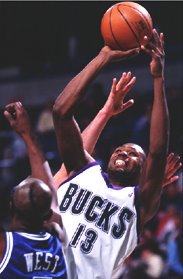
Note that the reverse of this strategy -- concentrating on the big men -- is much harder to do. Sure you could try to disregard guard-stat oriented players, but the overall shallow talent pool and steep drop-off after about 20 big men, makes the "big ball" strategy very hard to do. For example, the top 30 or so big men begins at Tim Duncan and ends at Danny Fortson (with Lamar Odom or Chris Webber in the middle). Many of the top big men have significant drawbacks, even discounting FT%, AST, STL, etc. Most of the big men who can score over 20 PTS a game will be long gone by the time you need them. Thus, it's much easier, and efficient, to field a squad of light, but accurate, shooters. Plus, as we all know from our first-hand basketball experience, it's so much more fun and demoralizing to bombs away (from 3-point land) and annihilate your opponent with precise missile strikes, ala the legendary Eric Agustin.
This primer is in no way meant to encourage or discourage a certain style of play, but it is meant to point out what is possible with our system, and to make sure everyone is aware that the initial balance of our 12-teams will be depend largely on recognizing what each individual owner is trying to do and keep that in context with what we are trying to do. We want to encourage variety in our team make-ups, but there is a slight potential for abuse of the system if a smart owner gets the opportunity and the motivation to field a small ball team.
The Beginning
 EXPECTATIONS
To be an active, alert, aware owner. I know football gets us overwhelmed, but we need good enthusiastic owners for this to work. Even if your team is the Hawks 2004, you have to be active on the wire, active everywhere to pull your team out of the doldrums. That's the only way we can play a keeper league. It's the worst when the bottom six teams in a league give up in January. If you're a quitter, quit now. "Wedding Crasher Rule #76: No excuses. Play like a champion."
MONEY
No cash prize, but this can be discussed. We typically play for a ring each year. We could do a trophy but none of us see each other, so really, I'm not sure how exciting this would be. I'd propose gifts such as "3 McFarlane figures" of your championship team for winning, etc. Something rather than nothing. To be discussed.
====================================================
KEEPERS
All players on the roster at the end of the year (before the keeper roster lock befoer the playoffs) will be on the roster for 3 years. Meaning there's no re-draft of current players except every three years.
ROSTERS
Full rosters will consist of 15 men. Note the lack of a season ending IR spot. If it's worth it to keep an injured guy, it's on your own dime.
SCORING
9 Non-weighted categories. PTS, AST, REB, STL, BLK, 3PT, FG%, FT%, TO
Each week you compete across all nine Head-to-Head and whoever wins the most categories that week receives a win.
LINEUPS
Play 10 men each week. No positional limits or minimums.
We set lineups weekly (Monday).
TRADES and WAIVERS
No waiver pickup limit, it'll be done in reverse order of the standings for each new transaction period. Waiver order resets weekly. All players cut from a roster hit waivers for 2 days. Then they become Free Agents. Any unaffiliated player is already a Free Agent.
Trades will be reviewed by the commissioners and only overturned if it seems terribly wrong. Otherwise, trade away.
Trade and waiver deadline will be decided when I set up the league (currently 3/12 for trades, 3/19 for waivers).
PLAYOFFS
The top 4 teams from each conference enter the playoffs. Top seeds have tie-breaker advantage should the scoring for the week come up even.
The final Championship Week is (possibly) more than seven days. Traditionally, the scoring goes more than the allotted seven days to make up for the last few days of the NBA regular season.
(amended from:) Top 3 teams from each conference make the playoffs. Start date for playoffs is unsure. First place team in each conference gets a bye.
The championship round will consist of (very likely) more than just one week. It usually goes about 1.5-2 weeks for some reason, just b/c of the NBA season. This also has the side effect of making the championship round a tad longer.
TOILET BOWL
To determine next year's draft order, we'll have a Toilet Bowl. The last and second-to-last place teams will duke it out for the #1 pick in the next year's draft (during the first week of our playoffs). The winner of that game gets the #1 pick, the loser gets #2. During that same week, the third-to-last and fourth-to-last teams play for picks #3 and #4. The fifth-to-last and sixth-to-last teams play each other for the #5 and #6 picks. Sounds confusing, it's not. It's incentive for every team to play competitively all year, even to just win their next year's draft pick.
ROSTER LOCK
Before our fantasy playoffs each year, we'll need to institute a roster lock. The purpose is two-fold. One, it lets the playoff contestants add/drop for their playoff run without ruining their keeper roster. Two, people can't snipe players this year for next year. Like grabbing a young guy just as the playoffs start to suddenly make him (or her) part of your keeper core. See, "Trades and Waivers" for lock time.
OWNERS - 6 East, 6 West.
East - Alvin, Brian, Eric A, Jose, Oliver, Reno.
West - Jon, Evan, Roger, Ping, Eric L, Trieu.
Subscribe to:
Posts (Atom)

 Posts
Posts

